The Philosophy
Why tarot and personal growth belong together.
How Does It Work?
The mirror, not the oracle
You draw a card. Your mind immediately starts interpreting it — through your current fears, hopes, and preoccupations. That interpretation is yours. Not the card's. That's projective psychology: an ambiguous image, and the meaning you assign reveals something real about your inner world.
Jung's active imagination
Carl Jung spent decades mapping the unconscious. He discovered that symbolic images — archetypes, dreams, mythic figures — could act as conversation starters between the conscious mind and the parts of yourself you'd buried or ignored. He called it active imagination. Tarot is one of the oldest tools for exactly this.
The 22 archetypes of the Major Arcana
The 22 Major Arcana aren't random. They map directly to Jung's universal archetypes — The Hero, The Shadow, The Self, The Trickster, The Wise Elder. These patterns show up across every culture, every mythology, every century. The tarot's Major Arcana is a visual vocabulary for the same territory.
The individuation process
Jung's central idea was individuation: becoming whole by integrating the parts of yourself you've hidden, rejected, or disowned. Shadow work. Inner child work. Values clarification. These aren't abstract concepts. They're the structure of the 90-day journey.
What's In It For Me?
Pattern recognition
Most people carry the same 3 to 5 patterns their entire lives. Imposter syndrome. People-pleasing. Fear of abandonment. Perfectionism. They show up in every relationship, every job, every crisis — just wearing different clothes. Naming them is the first step to changing them.
Emotional clarity
Daily reflection builds a record of your inner weather. After 90 days, you'll see what triggers you, what energizes you, and what you've been quietly avoiding. That's not mysticism. That's data.
Identity work
The archetype quiz isn't a personality test. It's a starting point. Your archetype shapes your personalized journey — the cards you're drawn to, the patterns that surface, the questions you're asked. It's a mirror held at a specific angle.
Structure, not randomness
This isn't journaling for its own sake. Day 1 is different from Day 45 is different from Day 90. You move through shadow work, values, purpose, relationships, and legacy — in sequence. Each stage builds on the last.
What to expect
By Day 30: you'll have names for your main patterns. By Day 60: you'll understand where they came from. By Day 90: a clearer picture of who you are and what you actually want.
Seven Angles. One Portrait.
One quiz shows you a door. Seven angles show you the house.
Most self-discovery tools give you a label and stop there. You're an INFJ. You're a 4. You're a Hermit.
FullTarot doesn't stop at the label.
Your archetype is the first angle. But you have seven. The shadow that runs your decisions. The values you claim versus the ones you actually live by. The voice inside that tells you you're not enough — where it comes from, what it sounds like. The patterns you keep attracting in relationships. The wound from your past still shaping your choices today.
Each quiz you complete fills another angle of your portrait. Not a profile. Not a personality type. A living psychological self-portrait — built one angle at a time, deepening with every pass.
The Seven Perspectives
- 1.Core Self — your dominant energy and how you move through the world
- 2.Shadow — the patterns running you unconsciously
- 3.Values — what you actually care about vs. what you say you do
- 4.Inner Voice — the critic that limits you, and where it came from
- 5.Patterns — who you attract, how you attach, what repeats
- 6.Element — how you process (through action, feeling, thought, or stability)
- 7.Origins — the wound from childhood still shaping your choices
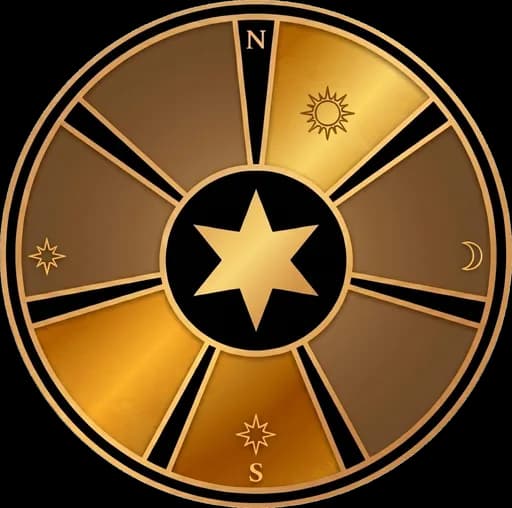
The wheel shows you how complete your picture is. And more importantly: which part of yourself you still can't fully see. That's where the real work begins.
What's the Research?
The numbers
30% of US adults consult tarot cards, astrology, or similar tools at least once a year. (Pew Research Center, 2024.) The global wellness economy reached $6.8 trillion in 2024 — growing 7.9% year over year. (Global Wellness Institute.) Worldwide consumer spend on mobile apps and subscriptions hit a record $150 billion in 2024. (Sensor Tower.) The US psychic services industry generated $2.3 billion in 2024. (AP/Pew.) These aren't niche behaviors. This is a mainstream human need.
Projective psychology
Projective techniques — where an ambiguous image is interpreted by the subject — are a well-established method in psychology. Your interpretation of an ambiguous stimulus reveals your inner world. The tarot card is the stimulus. Your reaction is the data.
Narrative therapy
Developed by Michael White and David Epston in the 1980s, narrative therapy holds that the stories we tell about ourselves shape our identity and our behavior. A tarot reading is a structured narrative exercise. You're building a story about who you are. That story has real consequences.
Jungian archetypes
Jung's theory of archetypes — universal symbolic patterns shared across cultures and centuries — is one of the most widely applied frameworks in psychology, therapy, branding, and storytelling. The Major Arcana is a direct visual expression of that system.
Habit formation
Behavioral change research consistently shows that daily practice, structured progression, and feedback loops are the drivers of lasting change — not single insight moments. The 90-day format is designed around this. One card isn't enough. Ninety days might be.
The disclaimer
FullTarot is a coaching and self-reflection tool. It is not therapy. It is not medical advice. It does not predict the future. For mental health support, please speak to a licensed professional.